
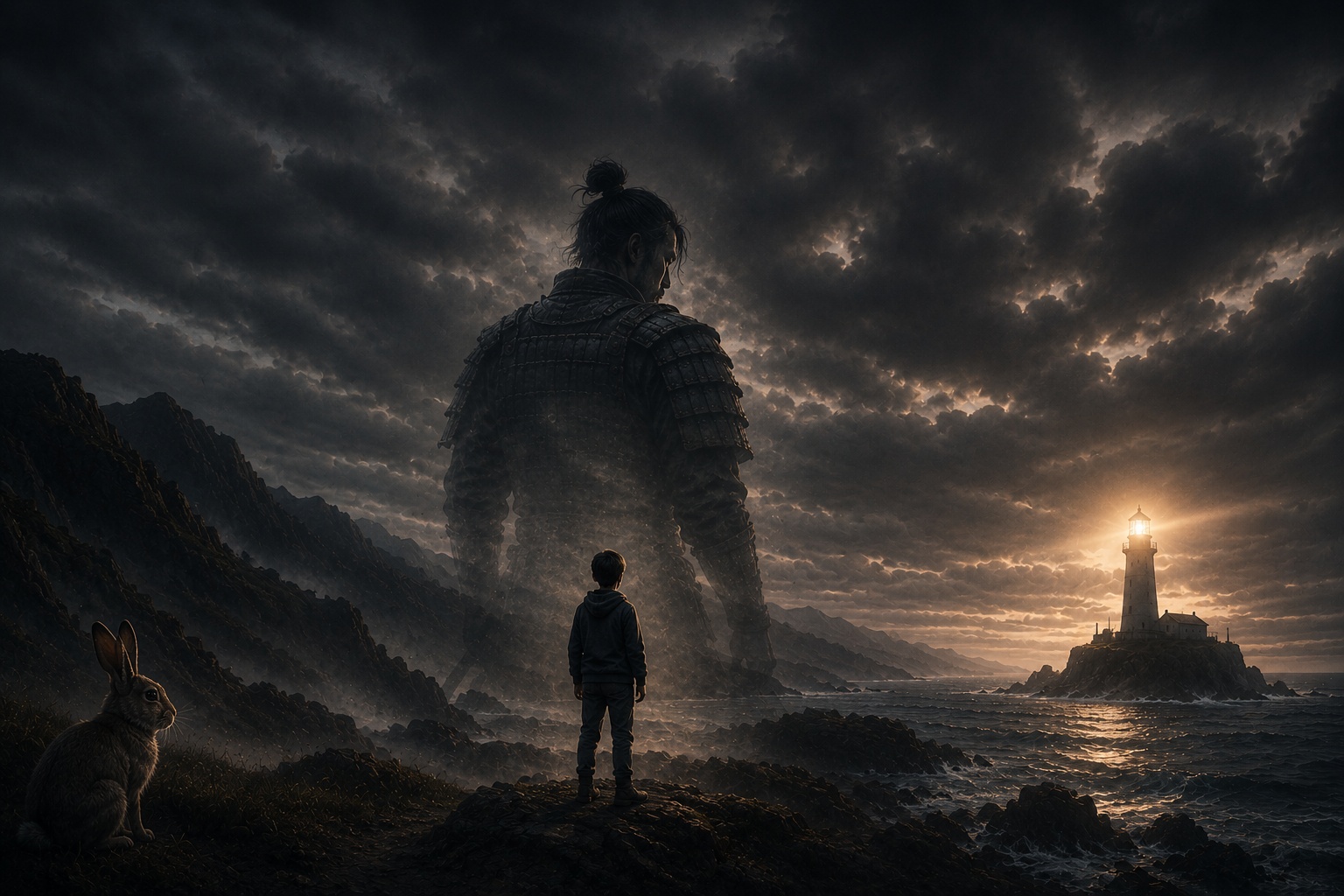
Growing in the Shadows
I was thirteen years old when I learned what I was made of.
Not in a way anyone saw, not in a way anyone celebrated.
I was running down the stairs toward the locker room before an ice hockey game, wide concrete steps covered in rubber, taking them fast the way you do when you’re young and certain your body will always cooperate. It didn’t.
I missed a landing.
The full weight of my body came down on my right ankle. The pain was the kind that takes your breath before you can even think to scream. The kind that turns the world white for a second. I sat there on those steps, tears coming before I could stop them, unable to inhale, unable to think.
And then I thought just one thing: don’t let them see it.
Not the tears. Not the limp. Not the weakness.
I got up. I barely walked to the locker room. My ankle was already swelling; I could feel it filling, tightening, pressing against the skin on the inside. I sat on the bench, dressed up, picked up my skate, and forced my foot inside.
The pain from tightening the laces is something I still remember. I pulled them as hard as I could, not to hurt myself more, but to contain the swelling enough to stand, to skate, to play.
I said nothing to anyone. I went on the ice and played.
The year after that, I found archery. The year after that, I was the national champion. I didn’t understand the connection then. I do now.
Both demanded the same thing: the ability to stay with discomfort without turning away.
I don’t tell this story because it was heroic. I tell it because it wasn’t. It was a thirteen-year-old boy so terrified of being mocked and bullied that he had learned, long before that staircase, to make himself small. To swallow what hurt. To never give anyone the satisfaction of seeing the crack.
I had been pointed at enough times to know that weakness, any weakness, was an invitation. So I disappeared inside the pain instead.
Quietly. Completely.
The way you learn to do it is when the alternative feels worse than the injury itself.
I didn’t know it then, but something in me was already changing.
Not because of the pain, but because of what I chose to do with it, alone, in silence, without anyone watching.
For as long as I can remember, I carried the feeling of being slightly outside. Not rejected in any dramatic way, just not quite inside the circle that everyone else seemed to move through so naturally. Always too much, too deep, out of sync.
I don’t think I’m alone in that. I think there are more of us than we admit, adults who carry, quietly and often invisibly, the unfinished business of a younger version of themselves. The child who felt overlooked. The teenager who never quite belonged. The young person who sensed something in themselves but couldn’t name it, couldn’t prove it, couldn’t make it real enough to believe in.
And so the search begins.
Mine looked like restlessness, different disciplines, different paths, always the next thing.
Always chasing people who seemed to carry that quality of being unshakeable from the inside.
Underneath all the movement was one question I couldn’t quite articulate: Can I become someone solid enough to finally respect myself?
What I couldn’t see then, what has taken me decades to understand, is that I was already becoming the person I was desperately searching for. The whole time.
While others saw only the quiet boy at the edge of the room, I was learning to hear without listening and see without looking, noticing what most people missed because they were too busy being noticed themselves. Growing quietly in the shadows, accumulating something that had no name yet.
What looked like shyness from the outside was something else entirely from the inside. It was patience. It was precision. It was the instinct of someone who understood, even without words for it, that real power doesn’t announce itself. It develops in silence. It grows in the margins. It waits.
I was not hiding because I was afraid. I was hidden because I was becoming the person who could one day hold a light for others.
If you recognise any of this, the feeling of being slightly outside, the restlessness, the quiet accumulation of something you couldn’t yet name, I want you to know something. You were not behind, you were not broken, you were absorbing. And everything you were taking in, all of it, was becoming the foundation of something real.
The qualities I spent my life chasing in others, courage, steadiness, depth, the capacity to stand, were already forming, slowly, in the very experience I was trying to escape.
Sensitivity became perception. Isolation became independence. The long hours of quiet observation became an instinctual ability to read people and situations that most never develop because they were never forced inward to find them.
The mature warrior is rarely the person who feels powerful all the time. More often, it is someone who knows fear, weakness, exhaustion, and self-doubt intimately, and continues to stand anyway. Not because they conquered those feelings. Because they stopped abandoning themselves to them.
The sensitive boy who felt small and outside the circle, he became the man capable of genuine compassion. Without him, whatever strength I built would have become hard. Without the warrior I chose to build, the boy might have stayed afraid.
The integration of both is where real strength lives. Not the elimination of the wound, but the transformation of it.
A lighthouse is not built on comfortable ground. It is built on exposed, isolated rock, precisely because that position, that kind of aloneness, is what allows it to be useful when the storm comes. It does not control the sea; it does not remove the danger. It stands, burns, and shows others where the rocks are.
Maybe that is what the whole journey was for. Not to become invulnerable, but to become just that.